Showing posts with label photography. Show all posts

Monday, 9 May 2011

usergeneratedprofiles - installations

Hi Liz: I have been thinking about the installation, and possible ways to 'map' our relationship online, and our blog.  I have a few ideas but I am aware that I do not want to project my ideas too much.  I often work in installation/ and or drawing, but it is important that there is elements of both our practices within the work.  As you say, once we get images of the space, this will help to form the development of the work.

Usergenerated blog 'Timeline'

Often development of many issues, relationship or history can be tracked by a 'timeline', which can be pin-pointed by visual and textual information, see below;


I have imagined that the timeline could function in a 'daydo rail', with us adding visual and textual significant developments along the timeline.  A possible way to use the time line, would be that the points on the upside of the daydo rail could be your interpretation, and the underside could be mine.  With regards to materials, we could use paint, pencil and photography, if we could work straight onto the wall?  The timeline would be adjunct to the rhizomatic nature of internet navigation, reflecting our journeys through a summarised, linear diagram.

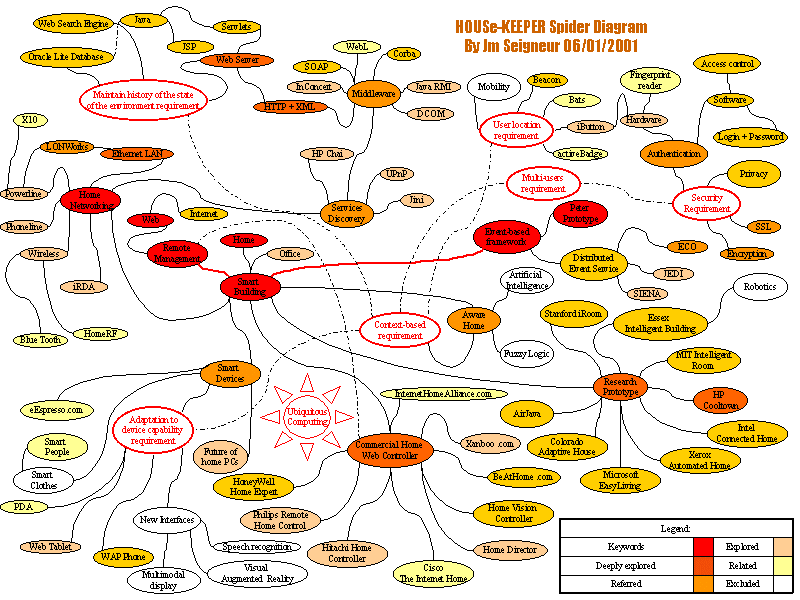
'Spider Diagram/ Chart'

We could chart our communication in a more multi-directional manner through a spider-chart diagram, which could also be made in similar materials as above.  See some examples of the visuals of spider charts -


'Profiles'
This is similar to my original idea where I thought we could get to know each other online, and write a profile for each of us, as we knew each other initally(which we first did upon the blog), and then a profile within the exhibition, once we have known each other for a period of activity upon the blog.  We could create a profile through drawing, painting for each other on the wall.


Let me know what you think...


Hi Jenny - hurray blogger is back up and working. Suppose it is all part of the process with trying to communicate and create your own content on-line. 

I am glad we are thinking along the same lines, I am interested in the timeline especially in terms of 'tracking our relationships' but I think the spider diagrams are more aesthetically interesting for an installation. I do drawing work and obviously photography but don't work in painting much at all so would not feel to confident working in that medium, but maybe that is all part of the experiment of working together. 
I have been making sketches of text based maps - I'll send them via the blog tonight. 
Once we have the images / dimensions of the space we will probably be able to push things forward! 

Send me any sketches once you have them and we can see what to work on. I am also going to start making some photographic works as well, just in terms of me responding to the 'concept of profiles'! 


Monday, 25 April 2011

Hi Jenny - Task 2 (25.04.11)

Jenny - we work in very different mediums and disciplines. If you had to respond to any of my work and link it directly to your practice which image or project would you choose? Feel free to search the web for my work...


Albermale Allotments, Manchester, 16/04/10
Hi Liz - I am interested in quite a few different elements of your practice, it seems there are a few divergent routes within it.  I was interested in the close up photographs, which we previously discussed, as 'evidence of human presence' through stains or used objects.  I am also interested in the references to 'make do and mend' architectural structures within the various communities that you have been exploring. For example, in the image above, where the inhabitants have recycled or used found objects to build architectural structures.  Within this series of images, I am interested in the practice of re-using objects to take upon another role, or construct temporary architecture.  I have been doing a lot of drawings of maps recently, juxtaposing digital layouts with physical town layouts, but I am interested in building three dimensional models, using found physical objects.  It reminds me of the Richard Wentworth series of images, that I often return to - 'Making Do and Getting By', where obtuse objects and ephemera take on a new role.  As my practice is heavily process and making based, it would be interested to explore the use of photography within 'making'.  Your work often carries an atmosphere of an 'older generations' set of values or nostalgia, which may be something also that we could investigate.

What would you say if I asked the question to you?

It is actually one of your earlier works that I am always drawn back to. I first spotted it when looking through your website for your Chongqing application and I always go back to it when I visit your web or want to show your work to someone else. With this particular piece of work it is the attention to detail and the emphasis on the small delicate object that I relate to. With my own work I often look for the unnoticed everyday object or surrounding and try to give it new importance through the view of the photography. The fact that you had used everyday objects and glorified them with such precision is what interests me in making work in general and in terms of installation work is something I am excited to develop, working with found and small everyday object, reworking and therefore re-evaluating them. And so this work from your 2007 installation is definitely the most relevant for me.


                        'From the other side of the screen it all looks so easy'


Saturday, 23 April 2011

Task 1 - Day 1

Tell me, why you wanted to become an artist when you began your further education? How has your understanding of being an artist evolved since this date?


Jenny: I wanted to become an artist because I have always loved to draw and make things more than anything else (this is starting to sound like a badly written UCAS statement!).  When I initially applied to art college, I wanted to study painting, but as I went through my first year studies at DOJCAD, I found I was more interested in working in a multidisciplinary manner.  At the beginning of my studies, I had a poor understanding of the professional practice involved with being an artist, and I do not think until I graduated did I start to glean a clearer idea of ways to support, finance an develop my practice.  Studying at Goldsmiths on the MFA certainly opened my eyes further to the endeavour of 'being an artist', the majority of achieving this is about getting 'on with it', and creating opportunities for yourself and your peers.

Liz: I guess I have always felt at home with the arts; visiting galleries, working in the art class, drawing, sketching, doodling, making, photographing - the works. I went to see Wolfgang Tillmans at Tate Britain when I was 16 and fell in love with his photography, I wanted to make work like that. I went back to school and told my art teacher that I wanted to do Fine Art Photography at the GSA but never thought I could or would actually do it, safer to do English Lit or Journalism maybe?? Then she said 'of course you should do it, you should only ever do something you love in life or you will never put your all into it'. And so I broke the bad news to my mum - 'I am going to try and be an artist'. I think she has just about forgiven me now, in fact I am sure she secretly likes it.

Since I graduated from Glasgow School of Art, (A place I adored and will always want to go back to) I had an initial six months panic about my life, but then 'indecisively decided' to try a bit of everything - internships, workshops, being an art teacher's assistant - the usual. In fact I tried to do so much that I actually forgot about the one thing I enjoyed the most - my practice, creating my own work. After a few years now though I have actually come to the conclusion that you need to surround yourself in a variety of creative environments - this way you can always stay inspired and hopefully opportunities come up where you can develop your work, skills and general professional practice. And by juggling a mixture of artist career paths - you can afford your dinner too.